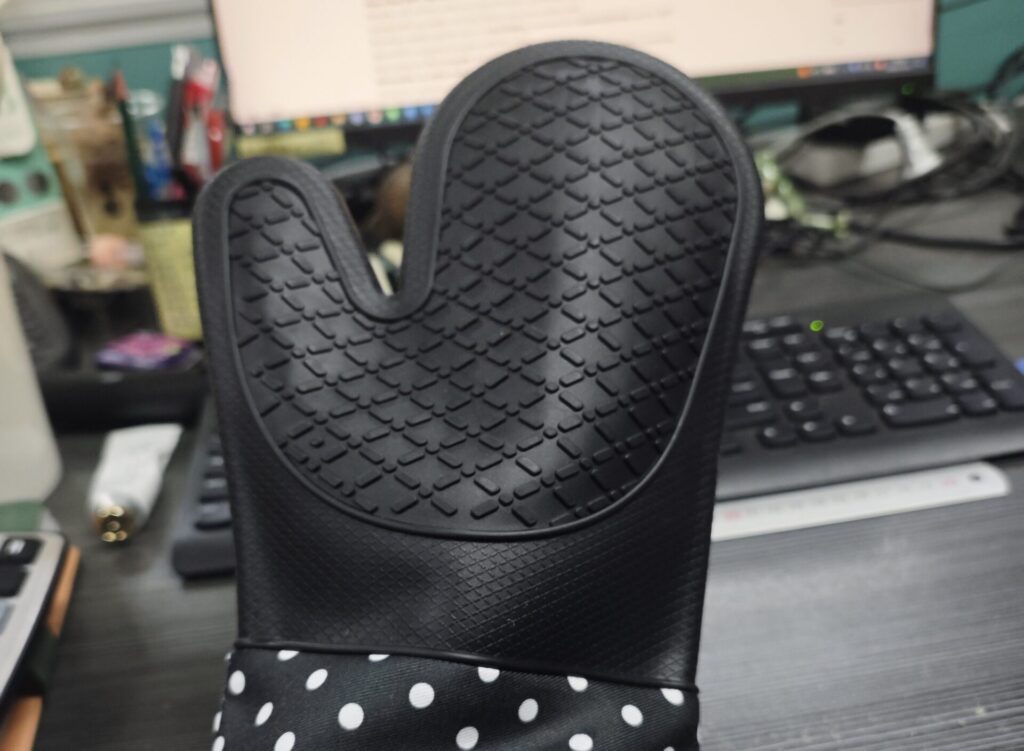
As a salesperson working in a silicone and plastic kitchenware factory, I often receive questions that sound simple on the surface, but become confusing once you look deeper. Recently, I received an inquiry from a Turkish customer about silicone oven gloves with cotton lining. The product itself is very common. However, one question led to a long discussion:
“Do you have CE certification?”
At first glance, this sounds like a routine compliance question. But as the conversation continued, it became a very typical example of how CE marking is often misunderstood in international trade, especially for kitchenware products.
In this blog, I want to share this real case in a simple and practical way, to help buyers and sellers better understand when CE is required, when it is not, and why clarity matters.
CE Is Not Only for Electronic Products – But It Is Not for Everything
The customer told me:
“CE is not only for electronic products.”
This statement is partly correct.
CE marking (Conformité Européenne) is a conformity mark required for products that fall under specific EU directives or regulations, such as:
Machinery
Personal Protective Equipment (PPE)
Medical devices
Toys
Radio and wireless equipment
However, not all products sold in the EU require CE marking. A product only needs CE if it is explicitly covered by an EU directive. This is where many misunderstandings begin.
What Is a Silicone Oven Glove, from a Regulatory Point of View?
A silicone oven glove with cotton lining is generally:
A household kitchen utensil
Used for short-time handling of hot trays or cookware
Not intended for industrial, professional, or occupational protection
This distinction is critical.
Under EU Regulation (EU) 2016/425, which governs Personal Protective Equipment (PPE), products intended for professional or occupational protection (such as welding gloves or industrial heat-resistant gloves) require CE marking.
However, household oven gloves are explicitly excluded from PPE scope.
That means:
Household oven gloves → No CE required
Industrial heat-protective gloves → CE required
The product category defines the certification requirement, not the material alone.
Where Did “280°C + CE + EN Standard” Come From?
The Turkish customer later replied:
“Customs says oven gloves must withstand around 280°C and need CE with an EN test report.”
This is where things become more complicated.
The reference to CE + EN standard + high temperature (280°C) strongly suggests a PPE heat protection standard, most likely EN 407.
EN 407 is designed for protective gloves against thermal risks, such as:
Contact heat
Convective heat
Radiant heat
Molten metal splashes
This standard is intended for industrial or professional use, not household kitchens.
In other words, the customs requirement may be mixing two different product concepts:
Household oven gloves
Industrial heat-protective gloves
These are regulated very differently.
Let’s Talk About Temperature – What Is Realistic for Silicone?
Another important issue is temperature.
In the kitchenware industry, food-grade silicone typically has:
Continuous heat resistance: around 230°C
Short-time contact resistance: up to 250–260°C, depending on formulation and exposure time
This matches real kitchen use:
Touching a hot oven tray
Holding a baking pan for a few seconds
No long-term exposure to extreme heat
A requirement of 280°C:
Is not a common household kitchen standard
Approaches or exceeds the safe working range of many food-grade silicone materials
Is usually linked to industrial protection testing, not consumer kitchen use
Therefore, when someone asks for 280°C resistance, the first question should always be:
280°C under what test method, and for how long?
Why “Just Do CE” Is Not a Simple Request
From the outside, CE may look like “just one certificate.” In reality, CE marking involves:
Correct product classification
Identifying applicable EU directives
Performing specific EN tests
Preparing a Declaration of Conformity
If a household oven glove is forced into a PPE framework, this would mean:
Redesigning materials and structure
Changing product positioning
Significantly higher testing and certification costs
A completely different market strategy
This is not a small adjustment. It is a product redefinition.
The Most Important Question to Ask: Which Standard Exactly?
In this case, instead of arguing whether CE is “right or wrong,” the correct approach is to ask for clarity:
Which EN standard is being required?
Is the product considered household or PPE by customs?
What are the exact test conditions (temperature, contact time, pass criteria)?
Without this information, suppliers cannot responsibly confirm compliance.
A Lesson for Buyers and Sellers
This real inquiry highlights a common issue in international trade:
CE is often treated as a 万能证书 (all-purpose certificate)
Product categories are blurred
Verbal customs feedback is taken as formal regulation
For buyers:
Always confirm the exact regulation and standard
Do not assume CE applies to all products
For suppliers:
Do not automatically agree to CE requests
Clarify classification before quoting or testing
Final Thoughts
Compliance is not about having “more certificates.” It is about having the right certificates for the right product.
A silicone oven glove designed for household use should be evaluated based on food contact safety and realistic kitchen conditions, not industrial PPE standards.
Clear communication, correct classification, and mutual understanding save both time and cost — and help avoid serious problems later in the supply chain.
If you are sourcing kitchenware from overseas, asking the right compliance questions early can make all the difference.