When it comes to developing new kitchen utensils, many buyers immediately think about “mold costs.” This is understandable—after all, in the world of silicone and plastic products, molds are essential. But when it comes to wooden kitchenware, things work quite differently.
At our factory, where we have been producing silicone and plastic utensils for three decades, we often receive questions from clients who wonder if wooden handles also require expensive molds. The short answer is: usually, no. Let’s explore why.
Silicone and Plastic Utensils: Molds Are the Core of Production
Silicone and plastic utensils are manufactured through injection molding or compression molding. In these processes, the mold is the heart of the production line.
- Every material needs its own mold.
For example, if a spatula has a stainless steel core, a nylon handle, and silicone on the outside, each layer must be shaped with its own mold. This can mean two or three separate molds for a single utensil. - High upfront investment.
Molds are not cheap. Depending on the complexity, a single mold may cost several thousand dollars. For a product with multiple materials, the total mold cost can easily exceed USD 4,000–5,000. - Longer lead time.
Building and testing molds typically requires 30–40 days before mass production can start. Once the mold is made, making any changes is costly and time-consuming.
This is why when buyers ask about developing a new silicone spatula or spoon, we need to calculate mold costs carefully. The mold is a necessary investment for shaping the product.

Wooden Kitchenware: A Different Story
Wooden kitchen utensils, or wooden handles combined with nylon/silicone heads, are not made through injection molding. Instead, the wood is crafted using cutting, turning, sanding, drilling, and surface finishing.
Here’s the key difference:
- No mold needed for shaping wood.
Most wooden handles are shaped directly by woodworking machines. Unlike silicone or nylon, wood does not need to be injected into a mold to take form. - Use of jigs and fixtures instead of molds.
In mass production, factories make jigs and fixtures to hold the wood pieces in place. These tools ensure consistency in size and shape, but they are much cheaper than a steel mold. - Flexible for design changes.
If a client wants to adjust the handle length, change the curvature, or add a hole for hanging, this can often be done by adjusting machine settings or making a new fixture—not by re-opening an expensive mold.
That’s why wooden handles are more flexible and cost-effective for buyers who are testing the market or prefer small-batch customization.
When Does Wood Require a Mold?
Of course, there are exceptions. In some cases, wood may still involve tooling:
- Bent or curved designs.
If a handle needs a special curve, the wood can be bent through heat and pressure, which requires a pressing mold. - Mass precision.
For large quantities where every millimeter matters, factories may use custom fixtures or tooling.
But even in these cases, the cost of wood tooling is much lower than that of silicone or nylon molds. The lead time is also shorter.
Comparing Wooden Handles and Silicone Unibody Utensils
So, what are the practical differences for a buyer when choosing between wooden-handle utensils and silicone unibody designs?
- Initial Cost
- Wooden handle: No expensive molds, only low-cost fixtures.
- Silicone unibody: High mold cost, especially for multi-material designs.
- Design Flexibility
- Wooden handle: Easy to adjust shape or style, perfect for testing markets.
- Silicone unibody: Once the mold is fixed, design changes are costly.
- Aesthetic and Market Positioning
- Wooden handle: Natural, warm, and high-end appearance—popular for lifestyle branding.
- Silicone unibody: Modern, minimalist, and durable—popular for professional or practical use.
- Production Speed
- Wooden handle: Faster to start production since there’s no mold-making stage.
- Silicone unibody: Slower to begin due to mold development.

Which Option Should You Choose?
It depends on your business goals:
- For new brands or small-batch testing: Wooden-handle utensils are the smarter choice. They reduce upfront costs, offer flexibility in design, and still deliver premium appeal.
- For long-term branding and high-volume sales: Silicone unibody designs are worth the mold investment. Once the mold is made, production is efficient, and the durability of one-piece silicone is a strong selling point.
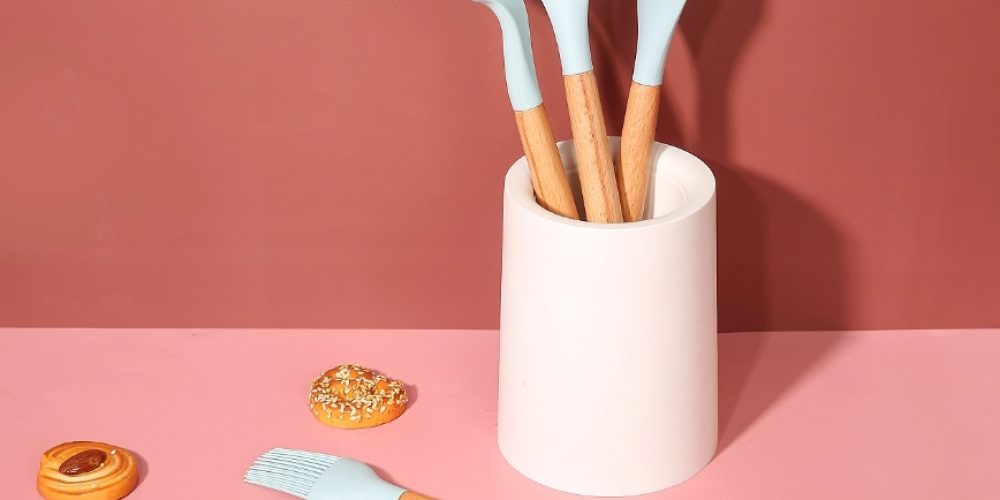
At our factory in Yangjiang, we produce both types: wooden-handle utensils like the ones in the photo above, and one-piece silicone tools. By discussing your budget, design, and market strategy, we can recommend the solution that balances cost and market demand.
Final Thoughts
Not every kitchen utensil requires expensive molds. Understanding the difference between materials and production methods is key to smarter purchasing decisions.
Wooden handles bring flexibility, lower costs, and natural beauty. Silicone unibody utensils, on the other hand, require mold investment but deliver sleek, durable performance. Both have their place in the market—it’s simply a matter of choosing what fits your brand strategy best.
If you’re considering a new utensil line and wondering about mold costs, let’s talk. With 30 years of experience in silicone, plastic, and wood kitchenware, we’re here to guide you through the process and help you launch products that sell.