When developing a new kitchen product, one of the most common questions from overseas buyers is:
“Does this product have any patent protection in our market?”
Recently, one of our European customers asked whether our collapsible silicone colander with an embedded 304 stainless steel reinforcing ring had any active patents in Switzerland. Instead of giving a quick “yes” or “no,” we conducted a structured preliminary patent search to better understand the potential intellectual property (IP) landscape.
This experience is a good example of how suppliers can perform an initial patent investigation before launching products into overseas markets.
Why Patent Searches Matter
Many manufacturers assume that if a product is widely available online, it must be free from patent restrictions. Unfortunately, that isn’t always true.
A patented product may still be sold by authorized distributors, licensed manufacturers, or even appear on multiple e-commerce platforms. Likewise, a product may have expired patents, design patents only, or utility patents that protect only specific technical features.
For importers and exporters, conducting a preliminary patent search helps:
- Reduce potential infringement risks
- Build confidence with buyers
- Support product development decisions
- Prepare for OEM and private-label projects
Although a preliminary search cannot replace a professional Freedom-to-Operate (FTO) opinion from a patent attorney, it provides valuable insight at an early stage.
Step 1: Clearly Define the Product’s Technical Features
Before searching any patent database, identify what makes the product unique.
For our silicone colander, the main features included:
- Food-grade silicone body
- Collapsible (foldable) design
- Drainage holes for washing fruits and vegetables
- Reinforced rim with an embedded 304 stainless steel ring
- Multiple size options
Instead of searching only the product name, focus on the technical characteristics. Patents are written around inventions, not marketing descriptions.
Step 2: Use Multiple Search Keywords
Different inventors may describe similar products using different terminology.
For this project, we combined keywords such as:
- Collapsible silicone colander
- Folding colander
- Silicone strainer
- Foldable kitchen colander
- Stainless steel rim
- Reinforced rim
- Silicone bowl with metal ring
Trying different keyword combinations helps uncover patents that might otherwise be missed.
Step 3: Search Official Patent Databases
A reliable patent search should begin with official or internationally recognized databases.
Some of the most useful resources include:
- Swissreg – the official Swiss intellectual property database
- Espacenet – maintained by the European Patent Office (EPO)
- Google Patents – useful for global keyword searches and patent family information
Searching multiple databases allows you to compare results and verify whether a patent is active in a particular country.
Step 4: Look Beyond the Product Name
One common mistake is assuming that a patent covers an entire product.
In reality, many patents protect only one specific innovation.
For example, a collapsible colander may have patents related to:
- Folding mechanisms
- Structural ribs
- Handle configurations
- Drainage patterns
- Locking systems
- Reinforcement structures
Therefore, even if two products look similar, their patented technical solutions may be completely different.
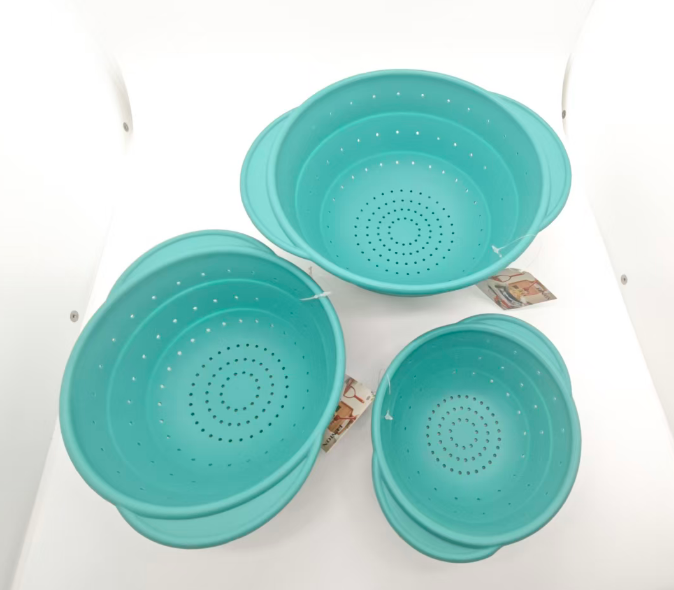
During our search, we found several historical patents covering general collapsible colanders and foldable kitchen bowls. However, we did not identify any active Swiss patent specifically protecting the combination of a collapsible silicone colander with an embedded 304 stainless steel reinforcing ring matching our product configuration.
Step 5: Check Patent Status
Finding a patent is only part of the process.
You should also determine whether the patent is:
- Active
- Expired
- Abandoned
- Withdrawn
- Valid in the target country
A patent filed in one country does not automatically provide protection worldwide. Many inventions are protected only in selected jurisdictions.
This is especially important for exporters serving multiple international markets.
Step 6: Draw a Careful Conclusion
After completing the search, avoid making absolute statements such as:
“There is no patent.”
Instead, professional reports typically use wording like:
“Based on our preliminary search, we did not identify any active Swiss patent specifically covering this product configuration.”
This language is more accurate because no preliminary search can guarantee that every relevant patent has been found. Patent databases are constantly updated, and legal interpretations may vary.
Final Thoughts
Patent searches have become an increasingly important part of international sourcing, especially for kitchenware, household products, and consumer goods.
A well-structured preliminary search can help manufacturers respond professionally to customer inquiries, reduce unnecessary risks, and demonstrate a commitment to intellectual property compliance.
At the same time, it’s important to recognize the limitations of a preliminary search. While it provides valuable information, it is not a substitute for a formal legal Freedom-to-Operate (FTO) opinion. If a product is intended for large-scale commercialization or involves significant investment, consulting a qualified patent attorney is always recommended.
For suppliers, understanding the basic logic behind patent searches is a valuable skill. It enables better communication with international buyers and helps build long-term trust by showing that product compliance is taken seriously.